

CASE STUDY
Rail Capacitor Failure Monitoring: Passenger Rail
Background
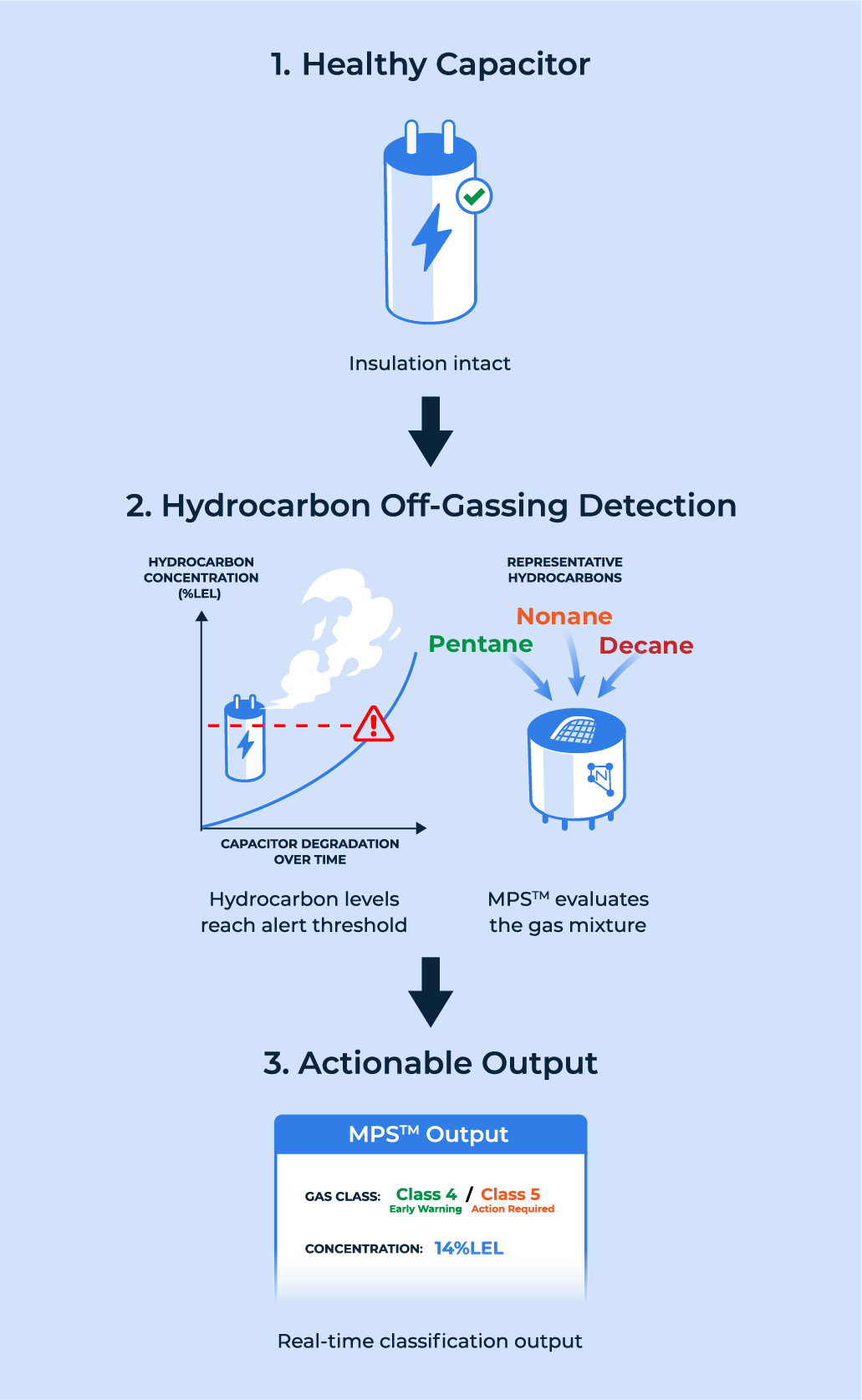
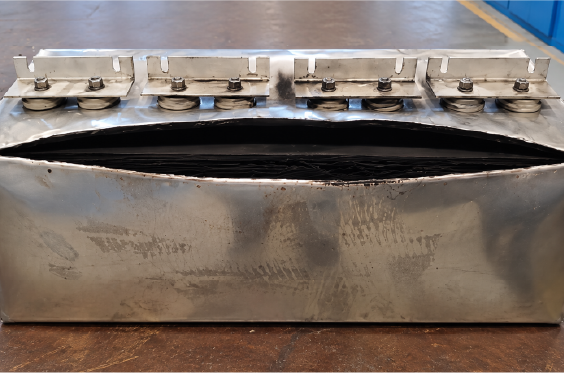
Modern rail systems rely on polypropylene film capacitors within traction power electronics to deliver reliable, efficient operation. Over time, these capacitors naturally age as electrical and thermal stresses degrade the dielectric material, releasing trace hydrocarbon gases well before visible signs of failure appear. If left undetected, capacitor degradation can eventually lead to excessive pressure buildup, capacitor rupture, equipment damage, unplanned downtime, or in severe cases, fire. Continuous detection of hydrocarbon off-gassing enables maintenance teams to identify degrading capacitors earlier and transition from scheduled replacement to a more predictive maintenance strategy.
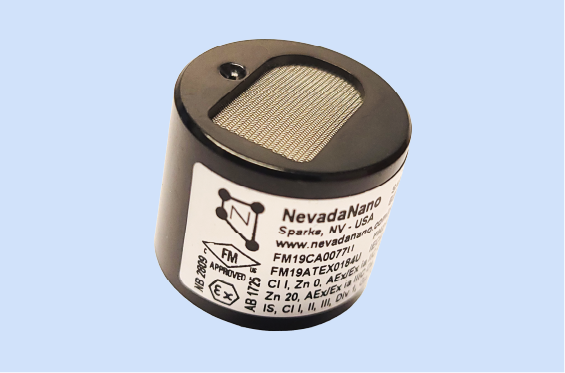
To address this challenge, a leading global rail transportation manufacturer integrated NevadaNano’s MPS™ Flammable Gas Sensor into its control unit to continuously monitor for hydrocarbon off-gassing associated with capacitor degradation. By providing continuous flammable gas monitoring inside the traction system, the solution enabled earlier identification of developing capacitor faults, helping operators improve asset reliability while reducing the risk of unexpected service interruptions.
Customer Need
This project involved a rail transportation manufacturer seeking to improve the reliability and safety of onboard electrical systems. Modern passenger trains rely on high-voltage traction equipment that uses polypropylene film capacitors to regulate and store electrical energy under demanding operating conditions.
These capacitors are expected to perform reliably over many years while being subjected to continuous electrical loading, temperature fluctuations, vibration, and other environmental stresses. As the dielectric material naturally ages, it can begin releasing hydrocarbon gases inside the sealed capacitor housing, providing one of the earliest indicators of impending failure. Detecting this off-gassing before catastrophic failure enables maintenance teams to intervene proactively, helping reduce unplanned downtime and improve system reliability.
Customer
Region
Application
Product
Equipment Monitoring
Gas Type
Challenges
Traditional maintenance strategies for rail traction capacitors often rely on scheduled inspections or replacement intervals, making it difficult to identify components that are beginning to fail between maintenance cycles. Because polypropylene degradation occurs gradually and releases a changing mixture of hydrocarbon gases long before catastrophic failure, the customer needed a reliable way to continuously detect these early warning signs and support a more proactive maintenance strategy.
Key challenges included:
- Detecting capacitor degradation before catastrophic failure occurs.
- Reliably identifying evolving mixtures of hydrocarbon gases rather than a single target gas.
- Maintaining accurate gas detection as gas composition changes throughout the degradation process.
- Providing continuous condition monitoring instead of relying solely on scheduled maintenance intervals.
- Reducing the risk of equipment damage, service disruptions, and potential fire through earlier fault detection.
- Reducing unnecessary capacitor replacement by supporting condition-based maintenance rather than strictly time-based replacement schedules.
NevadaNano's Solution
NevadaNano collaborated with the customer to evaluate and support deployment of its MPS™ Flammable Gas Sensor for continuous monitoring of hydrocarbon off-gassing associated with polypropylene capacitor degradation. Laboratory testing was performed using representative hydrocarbon mixtures generated during polypropylene decomposition to characterize sensor performance under expected operating conditions.
The evaluation demonstrated the sensor’s ability to reliably detect evolving hydrocarbon gas mixtures while providing the long-term stability, poison resistance, and maintenance-free operation required for demanding rail environments. Integrated into the customer’s control unit, the MPS™ Flammable Gas Sensor continuously monitors for flammable gas accumulation and reports gas classification with concentration as a percentage of the Lower Explosive Limit (%LEL), providing maintenance teams with earlier visibility into developing capacitor faults and supporting a predictive maintenance strategy.
Process and Implementation
To evaluate the suitability of the MPS™ Flammable Gas Sensor for onboard rail applications, NevadaNano conducted a structured evaluation of polypropylene capacitor degradation, the associated hydrocarbon off-gassing, and sensor performance under representative operating conditions. The following steps summarize the technical evaluation that supported deployment within the customer’s traction system.

1. Understanding Capacitor Degradation
As part of the evaluation, NevadaNano first examined the degradation process of polypropylene film capacitors to understand how failures develop and when hydrocarbon gases begin to form.
Polypropylene film capacitors naturally degrade throughout their service life as electrical and thermal stresses slowly break down the dielectric material. During this degradation process, flammable hydrocarbon gases are generated well before catastrophic failure, providing an opportunity for earlier fault detection. Identifying these gases early provides valuable insight into capacitor condition and supports more informed maintenance decisions before failures progress to equipment damage, service disruptions, or fire.
2. Characterizing Hydrocarbon Off-Gassing
Based on the expected degradation mechanism, NevadaNano characterized representative hydrocarbon gases released during capacitor decomposition.
Testing focused on the hydrocarbon gases generated during polypropylene decomposition. The evaluation identified representative decomposition products including butene, pentane, pentene, and decane, all of which are flammable.
Laboratory testing evaluated representative hydrocarbon mixtures containing pentane, nonane, and decane to assess sensor performance across evolving gas compositions. Understanding these gas characteristics was an important step in determining whether the sensing technology could reliably detect the early signs of capacitor degradation.
These representative hydrocarbon mixtures provided the basis for evaluating the MPS™ Flammable Gas Sensor’s ability to detect changing gas compositions associated with capacitor off-gassing.
3. Validating MPS™ Flammable Gas Sensor Performance
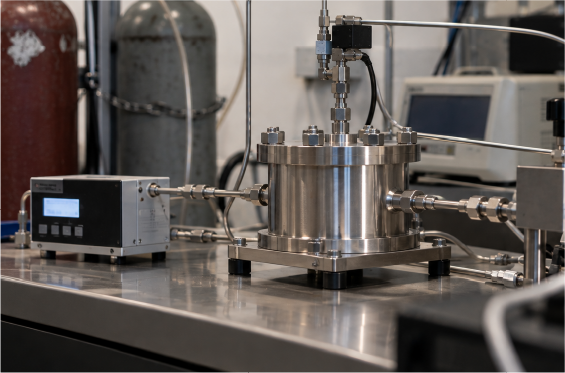
NevadaNano conducted controlled laboratory testing to validate the MPS™ sensing technology across changing hydrocarbon gas compositions. Testing included combinations of octane with methane and butane to observe how the sensor responded as gas composition changed. The results demonstrated the sensor’s ability to classify changing gas mixtures throughout the evaluation, supporting its suitability for detecting hydrocarbon off-gassing associated with capacitor degradation.
Learn more about how MPS™ Gas Classification Technology identifies and responds to different flammable gas classes.

4. Supporting Early Detection
Laboratory evaluation confirmed that the MPS™ sensing technology could reliably detect the evolving hydrocarbon gas mixtures associated with polypropylene capacitor degradation. By continuously monitoring these changing gas compositions, the technology demonstrated its ability to provide an early indication of capacitor health before catastrophic failure occurs.
Results and Impact
The MPS™ Flammable Gas Sensor provides a practical solution for continuous monitoring of hydrocarbon off-gassing associated with polypropylene capacitor degradation in rail traction systems. By continuously monitoring for flammable hydrocarbon gases, operators gain earlier visibility into developing capacitor faults, supporting a more predictive maintenance strategy while reducing the risk of unexpected equipment failures.
Deployed across more than 200 rail vehicles, the MPS™ Flammable Gas Sensor has demonstrated its suitability for long-term operation in demanding rail environments. Integrated into the customer’s control unit, the sensor provides reliable detection of evolving hydrocarbon gas mixtures while delivering the long operational life, stability, and maintenance-free performance required for critical onboard applications.
Key Benefits:
• Continuous monitoring of hydrocarbon off-gassing associated with polypropylene capacitor degradation.
• Earlier visibility into developing capacitor faults to support predictive maintenance.
• Reliable detection of evolving hydrocarbon gas mixtures using a single factory calibration.
• Automatic gas classification with concentration reported as a percentage of the Lower Explosive Limit (%LEL).
• 15+ year operational life with no field calibration required throughout the sensor’s lifetime.
• Extremely poison resistant and immune to saturation for long-term reliability.
• Reliable operation across temperatures from -40°C to 75°C and up to 100% relative humidity.
• Global certifications and approvals supporting international rail deployments.