
Gas Classification Technology for Combustible Gas Detection
Gas Classification Technology, embedded in the MPS™ Flammable Gas Sensor, reports a Gas Class ID alongside %LEL data to give multi gas detectors a clearer picture of what’s in the environment. Resulting in smarter detection, more informed alarm logic, and improved safety.
The Limitation of Traditional Combustible Gas Sensors
Legacy combustible gas sensors — catalytic bead (pellistor) and NDIR types — detect that a gas is present, but they cannot identify what gas it is. This creates real problems in the field:
- A site with multiple flammable gases forces operators to guess which gas to calibrate for
- Mixed-gas environments produce unreliable readings because the sensor has no awareness of gas type
- Alarm logic and response strategies are one-size-fits-all, even when different gases warrant different responses
Gas Classification technology directly addresses this gap.
What Is Gas Classification Technology?
Gas Classification is the process by which the MPS™ sensor analyzes detected gases and assigns them to a class based on their thermodynamic and molecular properties. Each sensor reading includes both a gas concentration value and a Gas Classification ID — identifying the gas family present, not just its %LEL level.
This makes the MPS™ more than a concentration sensor. It’s a multi gas sensor that understands what it’s measuring.
A couple real-world examples
Hydrogen–Methane Mixtures at Oil & Gas Facilities
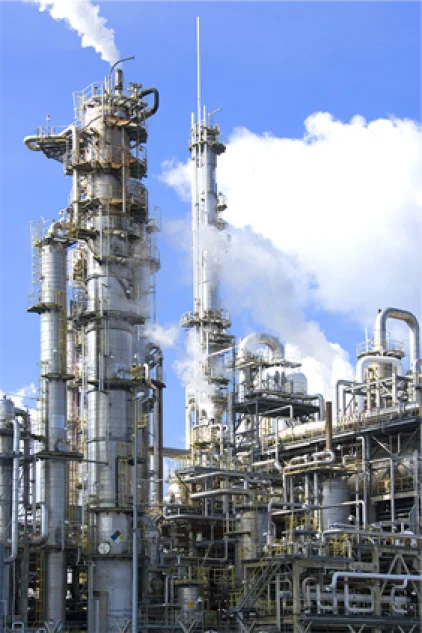
At oil and gas sites that are beginning to blend hydrogen into natural gas streams, workers may encounter leaks involving hydrogen, methane, or a mixture of both. A traditional sensor calibrated to a single gas, such as methane, can incorrectly report or miss hydrogen and mixed hydrogen/methane leaks entirely.
If a gas leak occurs at a piece of equipment in the blending process, the MPS™ sensor is able to classify the gas as hydrogen (Class 1), methane (Class 3), or a blended mixture of both (Class 2) and then automatically apply the correct k-factor to report an accurate %LEL without any manual calculation or judgment required by the operator.
The real time combination of Gas Classification ID and %LEL concentration gives workers immediate clarity about what kind of flammable gas is present and how close conditions are to the explosive range. This combination supports faster hazard recognition and safer decisions in environments where multiple flammable gases can be present.
Propane vs. Methane Leaks in Industrial Warehouses
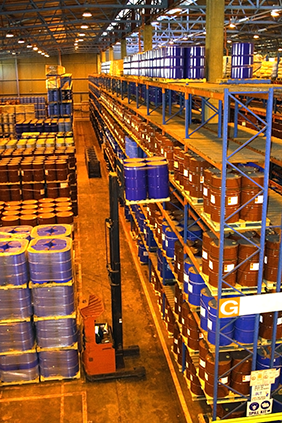
Warehouses and logistics hubs often have both propane powered forklifts and methane based heating systems, creating an environment where leaks from different gases can occur and require different safety responses. Traditional sensors are typically calibrated with a single gas such as methane. When exposed to propane or a mixture of propane and methane, the gas reading may underreport.
The MPS™ sensor can automatically classify the gas as propane (Class 4), or methane (Class 3). In the event that a mixture of methane and propane is present, The MPS™ will automatically determine which gas dominates the mixture, report the corresponding Gas Classification ID, and the average %LEL concentration of the mixture.
This gives workers immediate clarity about which gas is present, and which equipment is the probable source of the leak. The end result is faster hazard recognition, more precise emergency response, and safer decision making in facilities where multiple flammable gases can be present.
How Gas Classification Works
The MPS™ sensor leverages the thermodynamic properties of air-gas mixtures — not combustion or chemical reactions — to fingerprint each gas or gas family.
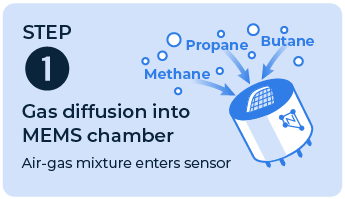
Measure
The MEMS sensing element captures heat transfer characteristics, molecular weight, and dynamic response across multiple temperature points.
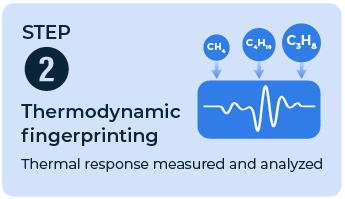
Analyze
Pattern recognition algorithms map the thermal response to a predefined gas classification space.
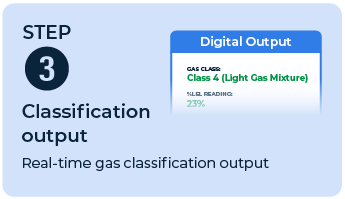
Output
A Gas Classification ID is reported in real time alongside concentration, updated continuously as conditions change.
No manual configuration. No gas preselection. No calibration required.
Gas Classification Categories

Class 1
Hydrogen
- Molecular weight: 2.0 [g/mol]
- Density: 0.09 [kg/m3]
- # carbons: 0

Class 2
Hydrogen Mixture
- Avg molecular weight: 1-14 [g/mol]
- Density: 0.1-0.6 [kg/m3]
- # carbons: varies
- Guarantees the presence of Hydrogen and another gas

Class 3
Methane (Natural Gas)
- Avg molecular weight: 16-19 [g/mol]
- Density: 0.6-0.9 [kg/m3]
- # carbons: 0-2

Class 4
Light Gas / Mixture
- Avg molecular weight: 25-75 [g/mol]
- Density: 1.2-2.5 [kg/m3]
- # carbons: 2-3
- Example Gases: Ethane, Propane, Isopropanol

Class 5
Medium Gas / Mixture
- Avg molecular weight: 55-120 [g/mol]
- Density: 1.5-4.0 [kg/m3]
- # carbons: 2-8
- Example Gas: Pentane

Class 6
Heavy Gas / Mixture
- Avg molecular weight: 80+ [g/mol]
- Density: 3.5+ [kg/m3]
- # carbons: 6+
- Example Gases: Octane, Toluene, Xylene
How Gas Classification and TrueLEL™ Work Together
Gas Classification is the foundation that makes TrueLEL™ possible. By identifying the gas family present, the MPS™ sensor automatically applies the correct sensitivity factor (k-factor) — eliminating the manual k-factor selection required by legacy sensors and enabling accurate %LEL measurement across a wide range of gases and mixtures.
How OEMs and Device Manufacturers Use Gas Classification
Gas Classification is accessible via the MPS™ digital interface, giving device manufacturers direct access to Gas Classification IDs alongside concentration and diagnostic data. This enables:
- Gas-specific alarm logic — trigger different responses based on the Gas ID detected
- Signal filtering — isolate or suppress specific gas families to match the target application
- Simplified architecture — replace multiple single-gas sensors with one multi gas detector
- Global deployment flexibility — a single device design that adapts to varying gas environments
Benefits of Gas Classification Technology
For Device Manufacturers
- No manual gas selection — Gas Classification ID is delivered directly from the sensor, ready to act on with no external algorithms needed
- Simplified architecture — replace multiple single-gas sensors with one multi gas sensor
- Advanced multi-gas logic — build gas-aware detection into your device using a single sensing platform
- Reduced system complexity — fewer sensors, simpler design, greater deployment flexibility
For End-Users
Greater situational awareness — know not just how much gas is present, but what class of gas is present
More reliable alarm responses — logic tuned to the actual gas class detected rather than a one-size-fits-all threshold
Confidence in mixed-gas environments — consistent performance where legacy sensors fall shor
Frequently Asked Questions About Gas Classification Technology
What is gas classification technology in combustible gas detection?
Gas Classification technology is the capability of the MPS™ sensor to identify the type of gas or gas mixture present — not just its concentration. The sensor outputs a Gas Classification ID alongside %LEL data, enabling gas-aware detection without manual configuration.
How is Gas Classification different from standard gas detection?
Standard combustible gas sensors measure concentration but have no awareness of gas type. The MPS™ uses thermodynamic fingerprinting to classify the gas family present, enabling more intelligent alarm logic and more accurate %LEL measurement through TrueLEL™.
What gas families does the MPS™ classify?
The MPS™ classifies gases into families including hydrogen, methane, light hydrocarbons, medium hydrocarbons, and heavy hydrocarbons. (Full table above.)
Can Gas Classification work in mixed-gas environments?
Yes. Gas Classification is designed to operate reliably in environments with mixed gases, changing gas compositions, and transient conditions — common in real-world industrial deployments.
View the application note on Measuring Flammable Gas Mixtures »
How does Gas Classification relate to TrueLEL™?
Gas Classification informs TrueLEL™ by identifying the gas characteristics present so the correct k-factor can be applied automatically. The two capabilities work together to deliver accurate %LEL readings across a wide range of gases without calibration.
How do I view the Gas Classification output?
The MPS™ digital UART communicates the Gas Classification ID in real time, alongside concentration and diagnostic data, enabling OEMs to build gas-aware logic directly into their devices.
Can I use Gas Classification to build a multi gas detector with a single sensor?
Yes. The MPS™ Gas Classification Technology allows device manufacturers can build a multi gas detector capable of distinguishing between gas families and responding accordingly.
Which sensor uses TrueLEL™ technology?
TrueLEL™ is a core capability of the MPS™ Flammable Gas Sensor, enabling accurate multi-gas leak detection with no calibration, reduced maintenance, and reliable performance in complex environments.