
TrueLEL™ Technology for Multi-Gas Leak Detection
TrueLEL™ is NevadaNano’s proprietary technology for multi-gas leak detection, delivering accurate real-time %LEL measurements across a wide range of flammable gases and mixtures—without calibration or manual k-factors.
The Challenge with Legacy Flammable Gas Sensors
Legacy flammable gas sensors (Pellistor/NDIR) require operators to know which gas is present and to calibrate the device specifically to that gas. During calibration, the detector assigns a single gas sensitivity factor (k-factor) that makes the sensor accurate for only that one target gas. If a site contains multiple flammable gases, users must choose one k-factor, forcing a compromise that can lead to inaccurate readings. This increases the risk of false positive or worse, false negatives.

Some real-world examples
Imagine a first responder entering a building that contains both propane and methane. If their catalytic bead sensor was calibrated to propane (k-factor 1.4), a room filled with 75% LEL methane could falsely appear as 105% LEL, triggering an overreporting alarm and slowing response efforts.
But the opposite scenario is even more dangerous: calibrating to methane (k-factor 1) and entering a room with 100% LEL propane would cause the device to underreport the concentration at just 72% LEL. That’s a false negative: a hazardous environment with no alarm to warn them.
This is the fundamental challenge with legacy %LEL technology—it was not designed for multi-gas, fast-changing environments.
What Is TrueLEL™ for Multi-Gas Leak Detection?
NevadaNano developed TrueLEL™ technology that solves the limitations of single-gas calibration associated with legacy sensor types.
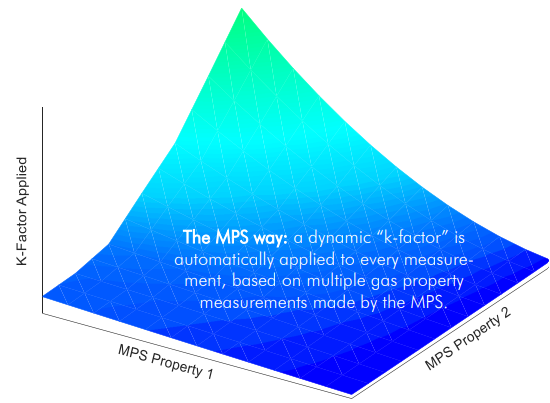
TrueLEL™ is our proprietary technology that enables accurate multi-gas leak detection by automatically identifying the gas characteristics present and applying the correct sensitivity factor (k-factor) in real time. TrueLEL™ is a core capability of the MPS™ Flammable Gas Sensor, enabling reliable multi-gas leak detection in complex industrial environments.
How TrueLEL™ Works
- Measure
The MPS™ sensor measures thermodynamic properties of the gas using its MEMS-based sensing element. - Analyze
Embedded algorithms analyze these properties using an onboard microprocessor to identify gas characteristics and behavior. - Apply
Based on the properties of the gas or gas mixture, the sensor automatically applies the correct k-factor and outputs an accurate %LEL reading, enabling accurate multi-gas leak detection across varying gas compositions.
In addition to %LEL measurement, the MPS™ sensor provides gas classification—offering insight into the type of gas or mixture present. This adds an additional layer of situational awareness not available in traditional %LEL sensors.
The MPS™ Detects All Combustible Gases
The MPS™ sensor supports multi-gas leak detection beyond the defined TrueLEL™ gases by responding to all combustible gases. This ensures hazardous conditions can still be detected even when the gas composition is unknown or not previously tested.
Find Your Gas
Don’t see your gas listed?
MPS™ sensors detect a wide range of flammable gases and mixtures. Contact us to discuss your specific application.
TrueLEL™ Performance Gases
The table below shows the subset of combustible gases that are verified TrueLEL™ performance gases—delivering validated accuracy across a wide range of gas types—from light hydrocarbons like methane to heavier compounds and oxygenated gases. Accuracy in the table varies based on the MPS™ sensitivity to the gas as well as how much the gas changes over the full environmental range.
| Gas* | Formula | Detection Range | Accuracy (0-50%LEL) |
|---|---|---|---|
| Butane | C4H10 | 0-100 %LEL | ±5 %LEL |
| Ethylene | C2H4 | 0-100 %LEL | -12 %LEL |
| Ethane | C2H6 | 0-100 %LEL | ±5 %LEL |
| Hydrogen | H2 | 0-100 %LEL | ±5 %LEL |
| Isobutane | C4H10 | 0-100 %LEL | ±5 %LEL |
| Isobutylene | C4H8 | 0-100 %LEL | ±6 %LEL |
| Isopropanol | C3H8O | 0-100 %LEL | ±10 %LEL |
| Methane | CH4 | 0-100 %LEL | ±3 %LEL |
| Methyl Ethyl Ketone | C4H4O | 0-100 %LEL | -12 %LEL |
| Pentane | C5H12 | 0-100 %LEL | ±7 %LEL |
| Propane | C3H8 | 0-100 %LEL | ±7 %LEL |
| Propylene | C3H6 | 0-100 %LEL | ±5 %LEL |
| Toluene | C7H8 | 0-100 %LEL | ±12 %LEL |
| Xylene | C8H10 | 0-100 %LEL | ±12 %LEL |
Table displays accuracies for the MPS™ 5.0 sensor. Each sensor has slightly different accuracies. Please check individual datasheets.
TrueLEL™ vs Traditional Flammable Gas Sensors for Multi-Gas Leak Detection
| Feature | Legacy Sensors | TrueLEL™ Sensors |
|---|---|---|
| Multi-Gas Leak Detection | No | Yes |
| K-factor Handling | Manual | Automatic |
| Field Calibration Required | Yes | No |
| Accuracy in Mixed Gas Environments | Variable/Uncertain | High |
| Maintenance | Frequent | Rare |
Benefits of the MPS™ Sensor and TrueLEL™ Technology
For Device Manufacturers
- Simplified integration – %LEL calculation and gas classification are handled directly within the MPS™ sensor.
- Ready-to-use outputs – onboard processing delivers final data to host devices with no additional computation required.
- Reduced system complexity – no manual gas selection or external algorithms needed.
- No calibration infrastructure – eliminates the need for gas delivery systems.
- Lower maintenance costs – minimizes service requirements, especially in remote or hard-to-access deployments.
For End-Users
Reliable, consistent readings – accurate gas detection with no drift over time.
No calibration required – eliminates downtime, maintenance, and recurring service costs.
Detects and classifies gases present – detects a wide range of flammable gases without requiring manual k-factor.
Improved safety and confidence – dependable performance even in complex or multi-gas environments.
Long operational life – up to 15 years of continuous performance without sensor replacement.
Low total cost of ownership – reduced maintenance, fewer service visits, and longer device lifespan.
Frequently Asked Questions About TrueLEL™ and Multi-Gas Leak Detection
What is TrueLEL™ in multi-gas leak detection?
TrueLEL™ is a technology that enables accurate multi-gas leak detection by automatically identifying gas characteristics and applying the correct sensitivity factor (k-factor) in real time. This allows precise %LEL measurement across different gases and mixtures without calibration or manual gas selection.
How does TrueLEL™ improve multi-gas leak detection accuracy?
Traditional sensors rely on a fixed k-factor based on a single calibration gas, which can lead to inaccurate readings in mixed-gas environments. TrueLEL™ automatically adjusts the k-factor in real time, ensuring accurate %LEL readings across varying gas compositions.
Does TrueLEL™ require calibration for different gases?
No. TrueLEL™ eliminates the need for field calibration by automatically applying the correct k-factor based on the detected gas or gas mixture, reducing maintenance and ensuring consistent accuracy over time.
How often do I need to calibrate the sensor to get TrueLEL™ accuracy?
The MPS™ sensor will maintain TrueLEL™ accuracy for the life of the sensor with no recalibration required.
Do I need to select what gas I want to detect?
No, with TrueLEL™ technology, the user no longer needs to input the gas they want to detect and calibrate to the gas. The sensor handles it all internally and even outputs a gas classification.
Can TrueLEL™ detect unknown or mixed gases?
Yes. TrueLEL™ enables multi-gas leak detection by analyzing gas properties in real time, allowing accurate %LEL measurement even when the gas composition is unknown or consists of multiple gases.
What happens if the gas is not a TrueLEL™ performance gas?
The MPS™ sensor detects all combustible gases, enabling multi-gas leak detection even outside the validated TrueLEL™ set. While accuracy specifications are defined for TrueLEL™ gases, hazardous conditions can still be reliably identified.
I can’t find my gas in the list of gases detected, does the MPS™ detect it?
If your desired gas is not in the TrueLEL™ gas list or the list in the gas finder tool above, please contact us for more information.
Which sensor uses TrueLEL™ technology?
TrueLEL™ is a core capability of the MPS™ Flammable Gas Sensor, enabling accurate multi-gas leak detection with no calibration, reduced maintenance, and reliable performance in complex environments.