CASE STUDY
Hydrogen Leak Detection: Production Facilities
Overview
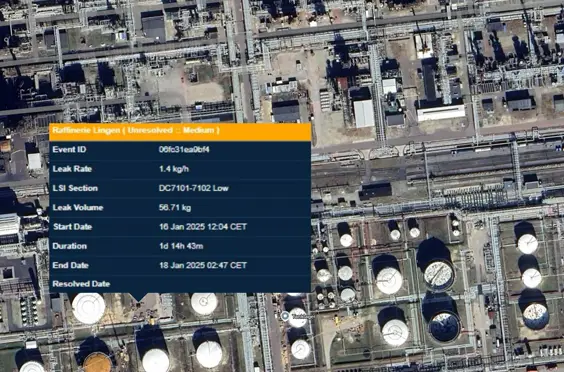
A leading downstream hydrogen producer partnered with NevadaNano to improve hydrogen leak detection across critical production infrastructure using continuous emissions monitoring. The deployment aimed to identify leak sources, better understand leak behavior over time, and compare measured emissions data against Computational Fluid Dynamics (CFD) gas leak modeling results.
About the Site
The deployment took place across multiple sections of an active hydrogen production facility, including production piping, tanks, valves, actuators, relief lines, and vertical stacks. These environments presented a broad range of potential leak scenarios and operational conditions, requiring continuous monitoring across both concentrated equipment areas and more complex vertical infrastructure.
The system was deployed across four monitoring sections spanning three primary site areas, providing visibility into emissions behavior across a variety of asset types and operating conditions.
Customer
Region
Installation Type
Product
Asset Monitoring
Gas Type
Challenges
Hydrogen presents unique monitoring challenges due to its small molecular size, high diffusivity, and broad flammability range. Even minor leaks can disperse quickly and behave differently depending on equipment configuration, pressure conditions, and environmental factors.
The customer required a monitoring solution capable of:
• Detecting hydrogen, methane, and blended gas emissions continuously
• Quantifying emissions with high accuracy over time
• Identifying leak behavior across different equipment types
• Supporting comparison between measured emissions and CFD modeling results
• Operating reliably across complex refinery infrastructure, including valves, tanks, piping, and stacks
NevadaNano's Role
NevadaNano deployed its EmissionsTrack™ continuous monitoring system to provide real-time detection and quantification of hydrogen and methane emissions across the facility.
The deployment included:
• 20 wireless LoRa endpoints configured to detect hydrogen (H₂), methane (CH₄), and H₂/CH₄ blends
• 1 centralized LoRa gateway for wireless communications and data transfer
• 1 LoRa-connected anemometer to support wind-aware leak localization and emissions analysis
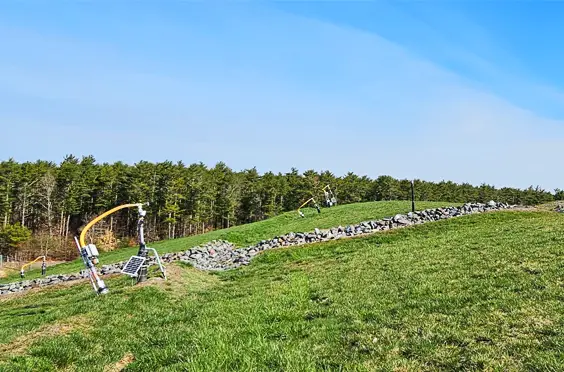
Battery-operated wireless endpoints were installed throughout high-priority monitoring locations, including valves, actuators, production piping, tank tops and bottoms, relief lines, and stacks.
Process and Implementation

1. Hydrogen Production Facility Monitoring Deployment
EmissionsTrack™ endpoints were deployed across four monitoring sections spanning three primary areas of the hydrogen production facility. Installation locations focused on equipment and infrastructure most susceptible to hydrogen emissions, including production piping, valves, actuators, tank tops and bottoms, relief lines, and vertical stacks.
The deployment utilized a wireless LoRa-based communications architecture consisting of 20 battery-operated endpoints, a centralized gateway, and a LoRa-connected anemometer, enabling rapid installation with minimal disruption to operations.
2. Continuous Monitoring and Emissions Analysis
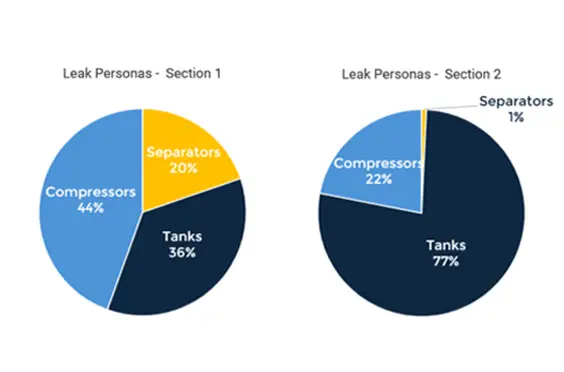
Once operational, the system continuously monitored hydrogen (H₂), methane (CH₄), and H₂/CH₄ blends in real time, enabling ongoing detection and quantification of emissions events across the facility. Over the course of the deployment, the system tracked emissions behavior across multiple equipment categories, allowing operators to compare leak frequency, duration, and emissions contribution under varying operational conditions. This analysis helped identify distinct leak personas across compressors, tanks, separators, valves, and other infrastructure, providing deeper insight into where emissions originated and how leak behavior varied between asset types.
The deployment also supported comparison between measured field data and Computational Fluid Dynamics (CFD) gas leak modeling results, providing additional insight into emissions behavior across complex refinery infrastructure.
3. Long-Duration Leak Visibility and Operational Insight
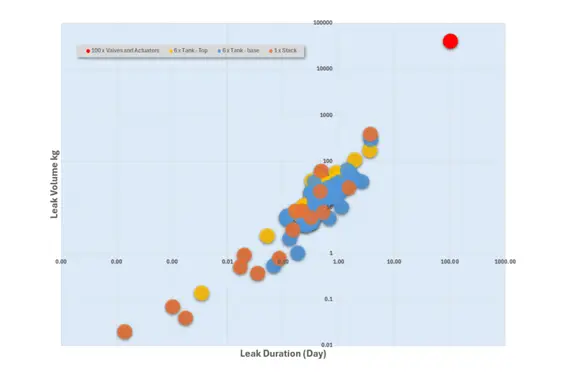
The deployment demonstrated the value of continuous monitoring for identifying persistent emissions events that may otherwise remain undetected under periodic inspection programs, including one leak that persisted for more than 100 days.
By providing continuous visibility into emissions behavior across the facility, EmissionsTrack™ enabled more targeted maintenance planning and improved LDAR efficiency. Operators were able to prioritize high-impact assets, better understand emissions drivers, and make more informed decisions regarding maintenance, equipment replacement, and long-term leak mitigation strategies.
Results and Impact
Over a three-month monitoring period, EmissionsTrack™ delivered continuous, high-fidelity emissions data across all monitored sections of the facility, revealing distinct emissions patterns across different equipment categories.
The deployment showed that valves and actuators represented the dominant source of ongoing emissions, contributing approximately 90% of measured emissions despite many leaks being relatively small and continuous in nature. This insight provided the operator with clearer visibility into which assets contributed most significantly to long-term emissions and where maintenance and equipment replacement efforts could deliver the greatest emissions reduction impact.
Tank emissions exhibited a different profile, characterized by shorter-duration, higher-frequency events often associated with operational pressure changes. These events provided valuable operational insight into tank behavior and pressure management practices.
Stack emissions presented a more complex monitoring scenario due to airflow variability and infrastructure complexity, though the system continued to provide reliable leak identification and emissions visibility.
The deployment also highlighted the importance of continuous monitoring in identifying persistent leak events that may otherwise remain undetected for extended periods. In one instance, the system identified a leak event persisting for more than 100 days, reinforcing the importance of continuous, site-wide visibility for identifying long-duration emissions sources.
By continuously quantifying emissions across a range of refinery equipment and operating conditions, the deployment helped improve LDAR efficiency, enable more targeted maintenance activities, and provide operators with deeper operational insight into equipment performance and emissions behavior over time.