
CASE STUDY
Thief Hatch Emissions Monitoring: Storage Tanks
Overview
An operator in Texas deployed MethaneTrack™ to monitor emissions from storage tank thief hatches, a known but often under-detected source of methane emissions. By implementing Close-Proximity Continuous Monitoring™, the operator gained real-time visibility into intermittent leak behavior, enabling faster detection and more effective maintenance workflows.
About the Site
The site is a typical upstream oil and gas facility with multiple storage tanks used for temporary storage of oil and produced water. Each tank is equipped with a single thief hatch designed to regulate internal pressure and prevent structural failure.
While essential for safety, thief hatches are considered a major source of both fugitive and operational (venting) emissions in oil and gas production, depending on whether they are malfunctioning or acting as designed.
Customer
Region
Installation Type
Product
Asset Monitoring
Gas Type
Challenges
Monitoring emissions from thief hatches is inherently difficult due to their intermittent behavior and the dynamic conditions inside storage tanks. Leaks are often short-lived and tied to pressure and temperature changes, making them difficult to detect and verify using traditional inspection methods.
Key challenges included:
• Differentiating between operational and fugitive emissions
• Intermittent emissions that are frequently missed by periodic LDAR inspections
• Difficulty verifying leaks in the field, leading to “no fault found” maintenance visits
• Limited visibility into when and where emissions events occur
• Inefficient maintenance workflows due to lack of real-time data
• Recurring leaks from mechanical components, including faulty seals and improperly secured hatches
NevadaNano's Role
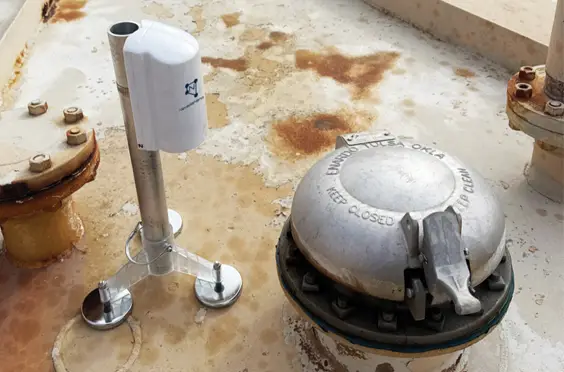
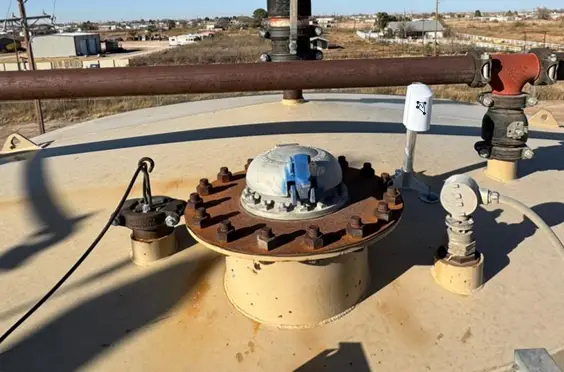
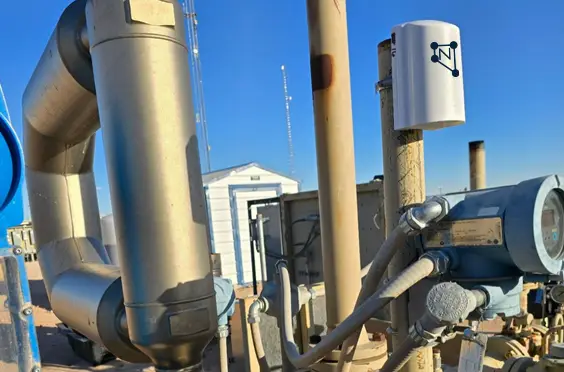
NevadaNano deployed MethaneTrack™ endpoints near thief hatches, enabling continuous monitoring directly at the emission source. The system provided real-time alerts combined with historical data visualization, allowing operators to understand emissions behavior over time rather than relying on isolated inspection events.
Process and Implementation

1. Targeted Thief Hatch Emissions Monitoring
Endpoints were installed near thief hatches and associated tank components, focusing on areas most prone to emission events. This close-proximity approach allowed the system to detect even small, intermittent releases.
2. Rapid Detection and Alerting
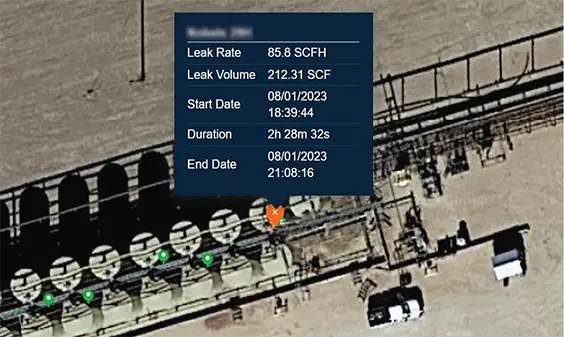
Within the first day of operation, MethaneTrack™ identified multiple emission events, providing operators with immediate visibility into active leaks that would likely have gone undetected using periodic inspections.
3. Identification of Specific Leak Sources
Using real-time alerts and location data, operators were able to isolate emissions to specific thief hatch locations. Investigation confirmed issues such as damaged seals and improperly secured hatches, allowing for targeted corrective action.
4. Historical Analysis and Optimized Maintenance Response
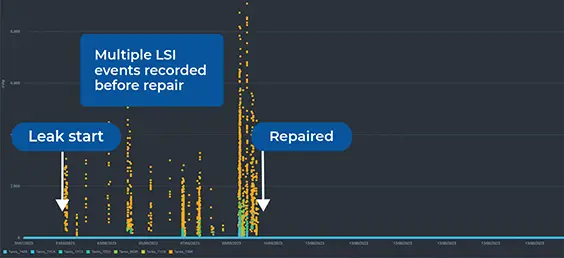
Operators leveraged historical emissions data to analyze leak patterns over time, identifying when emissions events were most likely to occur and how they correlated with tank pressure and environmental conditions. This enabled maintenance teams to better time site visits, focus on active fugitive emissions, and improve the likelihood of verifying and resolving issues during the first response.
Results and Impact
The deployment delivered a clear improvement in both emissions detection and maintenance efficiency by providing continuous, real-time visibility into thief hatch behavior. MethaneTrack™ identified multiple leak events within the first 24 hours of operation, demonstrating how quickly intermittent emissions can be detected when monitoring occurs directly at the source. These events were traced to specific thief hatches, where issues such as damaged seals were confirmed and repaired.
Continuous monitoring revealed that emissions were not constant but occurred under specific operating conditions, often tied to pressure changes and temperature fluctuations within the tanks. This insight allowed operators to move beyond snapshot-based inspections and begin understanding the true behavior of emissions over time.
Maintenance workflows improved significantly as a result. By using historical emissions data to guide response timing, operators reduced the frequency of “no fault found” visits and improved first-time fix rates. This led to more efficient use of field resources, reduced operational downtime, and faster resolution of emissions events.
Even after initial repairs were completed, additional intermittent leaks were detected, reinforcing that emissions at thief hatches are often recurring rather than one-time issues. The deployment demonstrated that continuous monitoring is essential not only for detecting leaks, but for maintaining long-term emissions performance.
The project successfully showed how close-proximity continuous monitoring enables faster detection, more precise repair, and a more efficient, data-driven approach to emissions management in upstream tank operations.