CASE STUDY
Permian Basin Methane Monitoring: Pilot Program
Overview
A leading Permian Basin operator partnered with NevadaNano to evaluate continuous methane monitoring technologies as part of a comparative trial against both traditional and emerging methane detection methods. The project was facilitated through a major engineering partner focused on delivering technologies that reduce operational costs and carbon intensity through actionable data and automation. By deploying MethaneTrack™ across key emission sources at a multi-asset upstream site, MethaneTrack™ identified previously undetected leaks and reduced methane emissions by up to 95% compared to conventional periodic LDAR methods such as OGI and Method 21 inspections.
About the Site
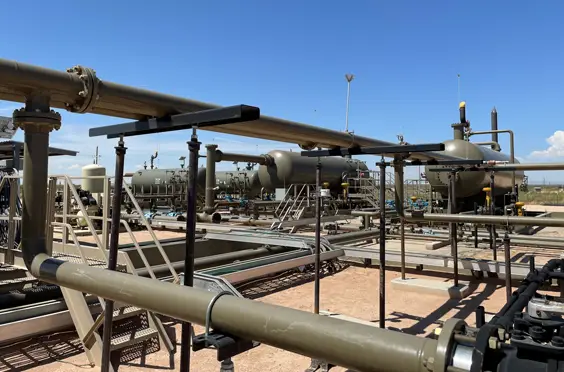
The site is an upstream oil and gas facility located in the Delaware area of the Permian Basin, spanning the Texas–New Mexico region, with the deployment occurring in New Mexico where methane monitoring regulations are more stringent. The facility included typical production and storage infrastructure, with the deployment focused on separators, vapor recovery units (VRUs), and storage tanks.
The project was executed in collaboration with a major engineering partner, enabling integration within an existing customer environment and supporting evaluation of continuous monitoring at scale.
Customer
Region
Installation Type
Product
Asset Monitoring
Gas Type
Challenges
• Intermittent emissions that were not captured by periodic LDAR inspections
• Increasing regulatory pressure, particularly in New Mexico
• Limited visibility into emissions from newly installed equipment
• Difficulty verifying and prioritizing leak repairs across multiple assets
• Lack of continuous data to understand recurring or equipment-specific emission behavior
NevadaNano's Role
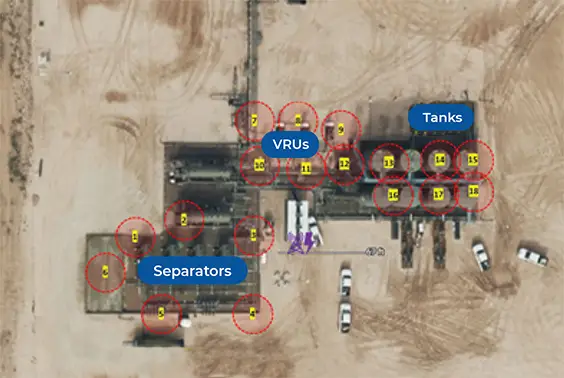
NevadaNano deployed MethaneTrack™ endpoints across separators, VRUs, and tanks, using close-proximity monitoring to capture emissions directly at the source.
The system leveraged LoRa wireless communication with cellular backhaul, enabling rapid installation using existing site infrastructure. Deployment was completed within hours, with immediate data visibility and no need for complex wiring or calibration.
Process and Implementation

1. Permian Basin Pilot Deployment Across Key Assets
Endpoints were installed directly around emission-prone equipment, including:
• Separators
• Vapor recovery units
• Storage tanks and thief hatches
The system utilized existing site infrastructure and cellular connectivity for immediate activation.
2. Close-Proximity Monitoring of Critical Components
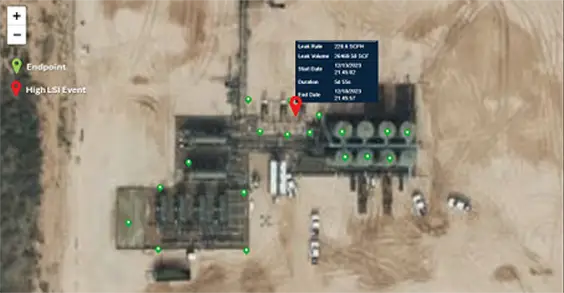
Endpoints were placed near known high-risk leak points, particularly around VRUs and tank thief hatches. This allowed for detection of emissions that would typically be harder to detect using traditional methods.
3. Identification of Undetected Equipment Leak
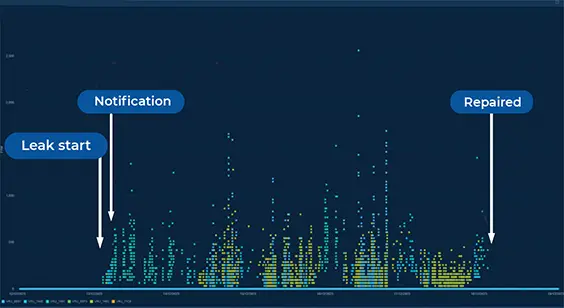
Shortly after deployment, MethaneTrack™ identified emissions from a recently installed VRU that had not previously been detected. The issue was localized quickly from the Leak Source Isolation ™ event generated by MethaneTrack™ which showed the start date time, hour leak rate (severity), total amount of gas emitted, and GPS location of the potential emission source.
4. Verification, Repair and Continuous Monitoring
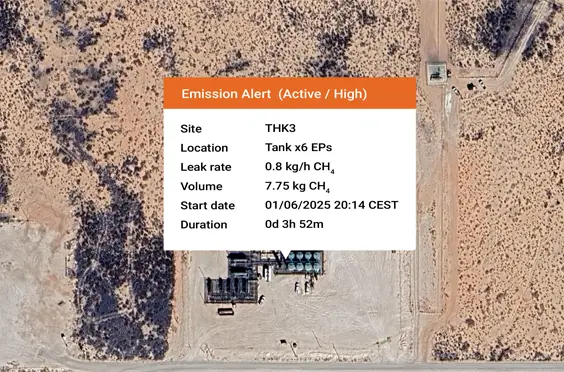
Following the repair, additional intermittent emissions events were later observed in the same area, demonstrating the importance of continuous monitoring for identifying recurring leak behavior and maintaining long-term emissions performance. The findings reinforced that even after corrective action, complex equipment and infrastructure can continue to develop new or intermittent leak conditions over time.

Results and Impact
The deployment delivered measurable improvements in both emissions visibility and operational response. By enabling continuous, close-proximity monitoring, the operator achieved up to a 95% reduction in methane emissions compared to traditional periodic LDAR methods such as OGI and Method 21 inspections.
MethaneTrack™ rapidly identified emissions from a newly installed VRU that could have gone undetected using conventional approaches, allowing operators to intervene quickly and prevent prolonged emissions. Following repair, emissions returned to baseline levels, confirming both detection accuracy and repair effectiveness.
As monitoring continued, the system captured additional emission events in the same area, reinforcing the limitations of one-time inspections and highlighting the importance of continuous visibility.
The deployment reduced time-to-detection from months to hours, enabling faster response and more efficient maintenance through targeted, data-driven decision-making.
This project is representative of broader adoption across the Permian Basin, where continuous monitoring deployments now span hundreds of sites and thousands of assets, supporting operators in meeting increasingly stringent regulatory and operational requirements.