CASE STUDY

Floating Roof Tank Emissions Monitoring: Storage Tanks

Case_Study_Floating_Roof_Tanks_Featured

Overview

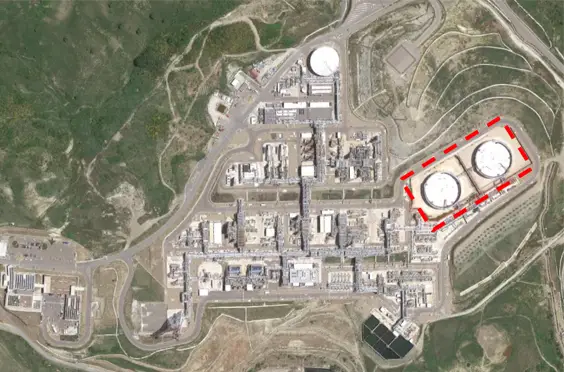
A global energy producer conducted a trial deployment of MethaneTrack™ at a European facility to better understand emissions from floating roof storage tanks. The objective was to measure, quantify, and analyze fugitive emissions from dynamic tank components that had historically been difficult or impossible to monitor using conventional methods.

About the Site

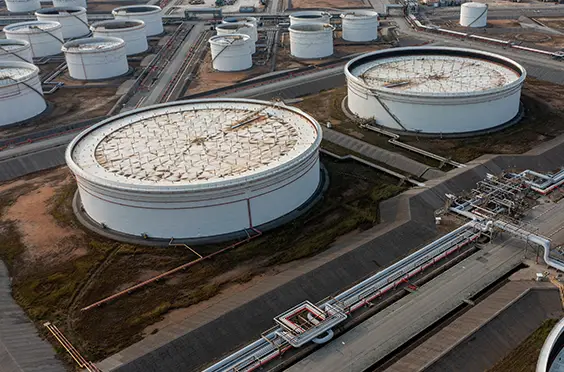
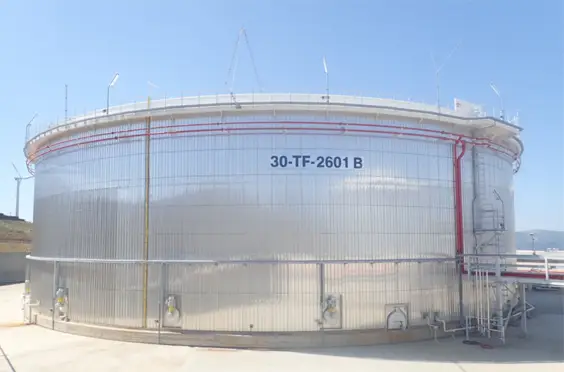
The site consists of large floating roof storage tanks, ranging from approximately 30 to 60 meters in diameter. These tanks store hydrocarbons and operate with a floating roof that rises and falls with product levels, creating a continuously changing mechanical and emissions environment.

The trial focused specifically on emissions from floating roof seals, tank perimeter interfaces, and pressure relief components during normal operation.

Case Study Floating Roof Tanks 2

Customer

Downstream Energy Operator

Region

Potenza, Italy

Installation Type

Floating Roof Tank Facility

Product

MethaneTrack™

Asset Monitoring

Floating Roof Tanks, Roof Seals, Pressure Relief Valves

Gas Type

Hydrocarbons / VOCs

Challenges

• Little to no visibility into emissions from floating roof tank seals
• Difficulty monitoring moving components (sliding seals and gaskets)
• Lack of continuous data linking emissions to tank fill levels
• Large tank sizes making traditional monitoring ineffective
• No existing technology capable of safely operating in this environment

NevadaNano's Role

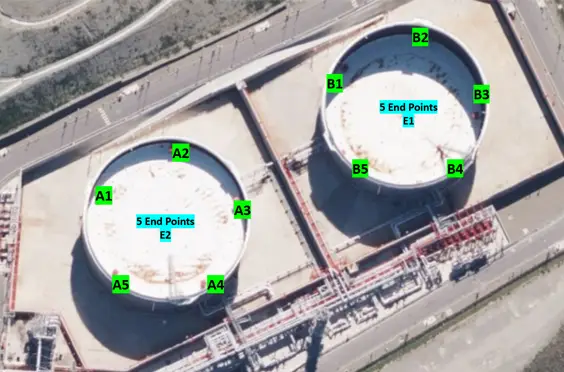
NevadaNano deployed MethaneTrack™ to provide continuous, close-proximity monitoring across critical floating roof tank components and potential emissions sources. Endpoints were strategically positioned around tank perimeter interfaces, floating roof seals, and pressure relief components to capture emissions directly at the source.

The deployment utilized a wireless LoRa-based monitoring architecture designed to operate reliably across large-scale tank infrastructure while minimizing installation complexity and operational disruption. By combining continuous monitoring with Leak Source Isolation™ (LSI™) analytics, the system enabled operators to detect, localize, and analyze emissions behavior in real time across dynamic tank operating conditions.

In addition to emissions detection, MethaneTrack™ provided operators with historical emissions visibility that could be correlated with tank fill levels, roof movement, and pressure conditions, supporting deeper operational insight and more targeted investigation of potential leak sources.

Process and Implementation

Case Study Floating Roof Tanks 1

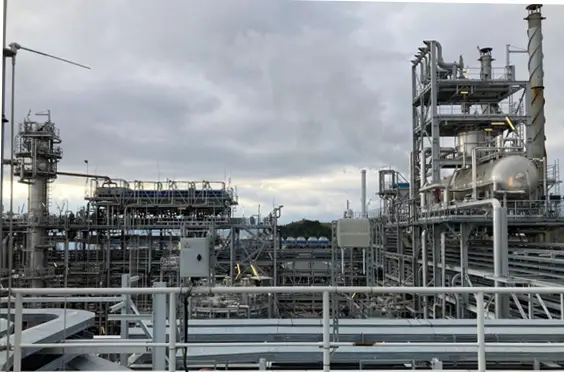
1. Strategic Placement Around Tank Perimeter

Endpoints were installed near:
• Floating roof seal interfaces
• Tank perimeter leak zones
• Pressure relief valves

This enabled monitoring of emissions from both structural and operational sources across the full tank circumference.
Case Study Floating Roof Tanks 4

2. Deployment of Wireless Network Infrastructure

A LoRa-based wireless network was established with a centralized gateway installed outside the hazardous zone. The system provided:
• Reliable long-range LoRa communication at scale, with endpoints connected up to 300 meters from the gateway
• Minimal installation complexity
• No need for extensive wiring or disruption to operation
Case Study Floating Roof Tanks 3

3. Monitoring Dynamic Floating Roof Tank Emissions

Continuous monitoring allowed operators to observe how emissions varied in real time based on:
• Tank fill levels
• Roof position and movement
• Pressure changes within the system
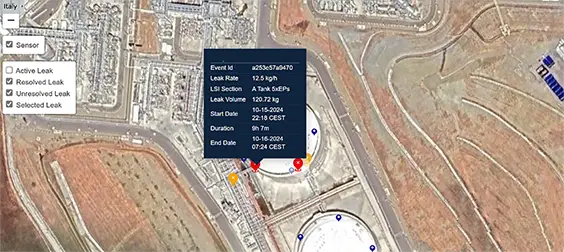
Emission details on MethaneTrack™ platform specifying location, volume and duration of leak

4. Detection of Emission Events and Root Cause Investigation

During the monitoring period, MethaneTrack™ detected multiple LSI™ events associated with one of the tanks. By analyzing emission patterns and correlating them with tank fill levels, operators identified a consistent relationship between emissions and a specific operating condition.

This data indicated a potential issue at a defined elevation along the tank wall.
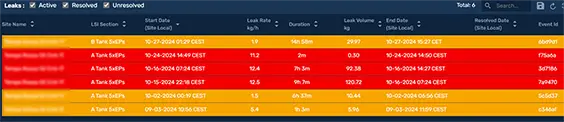
LSI events displayed on the MethaneTrack™ monitoring dashboard

5. Field Verification and Confirmation

On-site inspection teams were deployed to investigate the flagged condition. Physical inspection confirmed damage to the tank wall in two locations at the predicted height, validating both the detection and localization capabilities of the system.
Results and Impact

The deployment delivered value-driven and actionable insight into one of the most complex areas of emissions monitoring. MethaneTrack™ provided continuous, close-proximity visibility into emissions from floating roof tanks, enabling operators to observe how emissions behaved in direct relation to tank operations, including changes in fill level, pressure, and roof movement. Critically, the system did not just detect emissions but enabled operators to identify and investigate specific leak events. By correlating emission data with operational conditions, the team was able to pinpoint a likely issue location, which was later confirmed through physical inspection as damage to the tank wall. This represents a significant shift from generalized detection to actionable, component-level insight.

The deployment also demonstrated the practical viability of continuous monitoring in a large-scale, hazardous tank environment. MethaneTrack™ operated reliably within an ATEX-regulated setting, while its wireless architecture enabled coverage across a complex site, with large tank diameters without requiring additional infrastructure or intrusive installation.

Beyond the immediate findings, the trial validated a broader use case for floating roof tank monitoring, an area where operators have historically lacked the tools to measure emissions with precision. The ability to detect, analyze, and localize emissions in this environment enables more targeted mitigation strategies, improved operational awareness, and scalable deployment across similar assets.

Related Case Studies

Landfill Emissions Monitoring: Gas Collection Optimization
Offshore Emissions Monitoring: Persian Gulf Platform
Compressor Station Emissions Monitoring: Permian Basin
Scroll to Top