
This article is part of our OGMP 2.0 Educational Series
View all the articles
- What Is OGMP 2.0?
- Emission Factors and Activity Factors Explained
- What Is a Methane Baseline?
- LDAR Programs for OGMP 2.0
- Operational vs. Fugitive Emissions
- Methane Quantification: Why It Matters
- Continuous Monitoring vs. Periodic Surveys
- What Are Fugitive Emissions?
- How to Detect Fugitive Emissions
- Upstream Methane Emissions Sources
- What Are Vented Emissions?
- Understanding Incomplete Combustion Emissions
- Achieving OGMP 2.0 Gold Standard
Understanding the Tradeoffs in OGMP Methane Measurement
Methane emissions from oil and gas operations are a major contributor to climate change. With growing pressure from regulators, investors, and the public, operators are increasingly adopting methane monitoring technologies to meet environmental targets and comply with frameworks like the Oil and Gas Methane Partnership (OGMP) 2.0. One of the most important strategic decisions is choosing between continuous methane monitoring and periodic surveys—two approaches that play different roles depending on compliance level, risk, and site complexity.
For operators seeking to achieve OGMP 2.0 Level 4 or Level 5 compliance, understanding the tradeoffs between these methods is essential.
What Is Continuous Methane Monitoring?
Continuous methane monitoring uses permanently installed sensors or wireless endpoint networks to deliver real-time data on methane concentrations and leak events. These systems detect and quantify emissions as they happen, giving operators the insight to respond quickly and prevent escalation.
This method supports OGMP 2.0 Level 4 and Level 5 reporting by:
- Capturing measured emissions data over time
- Providing source-level quantification for key emission points
- Supporting site-level reconciliation and inventory generation
Modern systems like the Close-proximity, Continuous Monitoring Sensor Networks deployed in solutions like MethaneTrack™ and EmissionsTrack™ offer low-maintenance, high-uptime performance. With Leak Source Isolation™ and quantification analytics, these technologies deliver continuous monitoring with actionable intelligence.
What Are Periodic Surveys?
Periodic surveys involve scheduled site visits using handheld detectors, OGI cameras, or drone-mounted sensors to detect methane leaks. Often used in early-stage LDAR programs, they offer a relatively low upfront cost and flexible deployment across large areas.
However, there are drawbacks:
- Emissions are only captured at the time of the survey
- Intermittent or short-duration leaks may go undetected
- Response delays can lead to higher environmental and regulatory risks
While periodic surveys can satisfy OGMP Level 3 reporting, operators pursuing Level 4 or 5 need more robust, data-driven approaches.
Comparing Continuous Monitoring and Periodic Surveys
| Continuous Monitoring | Periodic Surveys | |
|---|---|---|
| Detection Frequency | 24/7, real time | Intermittent (scheduled visits) |
| Leak Duration Capture | Yes | No |
| Supports OGMP Level 4 & 5 | Yes | No (Level 3) |
| Operational Burden | Low after install | High labor demand |
| Data Quality | High, timestamped | Limited, often qualitative |
| Cost Over Time | Higher upfront, lower O&M | Lower upfront, high recurring |
| Leak Source Localization | Yes | Often requires follow-up |
Why Repair Timing Matters
Detecting a methane leak is only part of the equation. The greatest factor influencing total methane emissions is often how long the leak remains active before it is repaired.
Periodic LDAR surveys provide a snapshot of site conditions at a single point in time. If a leak develops shortly after a scheduled inspection, it may continue releasing methane for weeks or even months until the next survey identifies it. During that time, emissions continue to accumulate, increasing product loss, environmental impact, and operational risk.
Continuous methane monitoring changes this timeline. By continuously monitoring critical assets, operators receive near real-time notification when an emission event begins, allowing maintenance teams to investigate and prioritize repairs much sooner. Reducing the time between leak onset and repair can significantly lower the total volume of methane released over the course of a year.
Repair Timing Drives Total Emissions
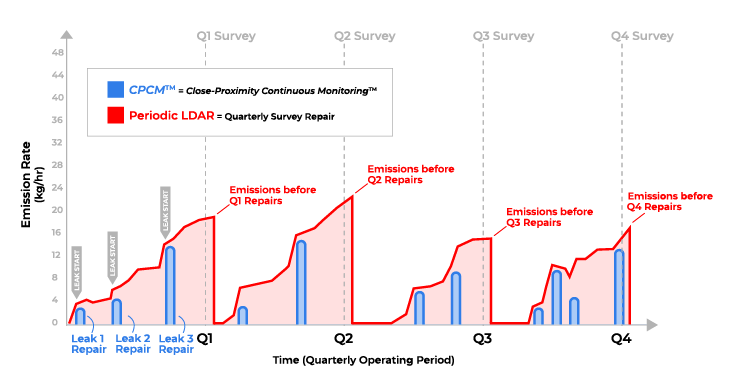
The illustration above demonstrates how two identical leak events can produce dramatically different total emissions depending on when they are detected and repaired. While periodic surveys may not identify a leak until the next scheduled inspection, continuous monitoring enables operators to respond much earlier, reducing the cumulative methane released before repairs are completed.
Key Takeaway: Continuous methane monitoring doesn’t reduce emissions simply because it detects leaks—it reduces emissions by enabling earlier repairs, resulting in significantly lower cumulative methane emissions than periodic survey programs.
Use Cases and Considerations
Periodic surveys are best suited for:
- Low-risk facilities with few leak sources
- Early-stage OGMP compliance (Level 1–3)
- Supplementing continuous systems for wide-area inspections
Continuous monitoring is ideal for:
- High-risk emission zones (compressor stations, tanks, wellheads)
- Operators targeting OGMP Gold Standard
- Reducing time to repair and prioritizing large, intermittent leaks
Looking Beyond Detection
While continuous monitoring significantly reduces emissions compared with periodic surveys, where sensors are deployed also has a major impact on detection speed and repair effectiveness.
Learn how Close-Proximity Continuous Monitoring™ (CPCM™) helps operators detect leaks closer to the source, localize emissions faster, and further reduce total site emissions.
The Future of OGMP Methane Measurement
As OGMP 2.0 evolves into a global benchmark for methane emissions, the shift from periodic to continuous monitoring is accelerating. The framework promotes measured, not estimated, emissions reporting—and that requires scalable, high-resolution monitoring technology.
For example, systems like MethaneTrack™ with Close-proximity, Continuous Monitoring™ wireless sensors offer unmatched performance with:
- Real-time quantification
- Continuous emissions inventories
- Integration with regulatory and operational dashboards
These innovations enable operators to meet OGMP Level 4 and Level 5 reporting with greater accuracy, lower risk, and faster remediation timelines.
Conclusion
When it comes to OGMP methane measurement, there’s no one-size-fits-all solution. But for companies focused on accuracy, transparency, and compliance with Level 4 or 5 standards, continuous methane monitoring delivers clear advantages over traditional periodic surveys.
As regulations tighten and expectations rise, proactive monitoring will be key to staying compliant, competitive, and climate-aligned.
Want the complete roadmap to OGMP compliance—from Level 1 to Gold Standard?

Achieving OGMP 2.0 Gold Standard Reporting
Read our guide Achieving OGMP 2.0 Gold Standard Reporting to learn the step-by-step framework, best practices, and technology insights you need to progress through every compliance level with confidence.