

Advancements in Gas Detection: Overcoming the Limitations of Traditional Technologies
Catalytic bead sensors — commonly called bead sensors or pellistors — have been the standard in flammable gas detection for decades. But persistent limitations around poisoning, saturation, and calibration drift are pushing OEMs to look for alternatives. NevadaNano’s MPS™ is the first truly innovative catalytic bead gas sensor replacement to enter the market in over four decades — addressing the fundamental shortcomings of bead sensor technology while combining the best of what came before it.
The Limitations of Catalytic Bead Gas Sensors
Catalytic bead sensors have been in use for nearly 100 years. They are popular because they are sensitive to nearly all hydrocarbons and relatively inexpensive. These sensors contain two small beads — one coated with a chemical catalyst, the other with an inert material. When powered on, the beads are heated to a high temperature. When hydrocarbon gases reach the sensing element, the catalyst-coated bead heats up more than the inert one, and the temperature difference provides a reading relative to the concentration of flammable gas present.
While this is a proven method of gas detection, catalytic bead sensors carry significant limitations that affect safety and total cost of ownership:
Poisoning
When a catalytic bead sensor comes into contact with higher hydrocarbons, alcohols, ketones, esters, hydrogen sulfide, or other sulfur-containing compounds, the catalyst becomes deactivated. Poisoned bead sensors often appear to be operating normally — an invisible hazard for personnel who may be inadvertently exposed to dangerous gas concentrations.
Saturation
Exposure to gas concentrations above the sensor’s designed measurement range can burn out the catalyst entirely. A saturated catalytic bead sensor may appear functional while failing to detect dangerous levels of gas.
Calibration Drift
Catalytic bead sensors are prone to sensitivity drift and degradation over time, requiring calibration up to four times per year to maintain safety-critical accuracy. Single-gas calibration also means the sensor outputs inaccurate readings for all other flammable gases present.
Single-Gas Limitation
If calibrated to methane, a catalytic bead gas sensor will output inaccurately for hydrogen, propane, and many other flammable gases. In mixed-gas environments this represents a significant and often undetected safety risk.
How the MPS™ Overcomes Catalytic Bead Sensor Limitations
NevadaNano’s Molecular Property Spectrometer™ (MPS™) uses a micro-electromechanical system (MEMS) transducer — an inert, micrometer-scale membrane with an embedded heater and thermometer — to measure changes in the thermal properties of surrounding gases. Rather than relying on chemical reactions like a catalytic bead sensor, the MPS™ measures physical gas properties, which is why it cannot be poisoned or saturated.
Resistant to Poisoning & Saturation
Because the MPS™ measures physical characteristics rather than triggering chemical reactions, it is immune to the contaminants that poison and saturate traditional bead sensors — silicones, hydrogen sulfide, alcohols, and higher hydrocarbons included.
No Required Field Calibration
The MPS™ is factory calibrated. Unlike a catalytic bead sensor that requires quarterly (or more frequent) calibration, the MPS™ requires no field calibration over its entire 15-year sensor life — eliminating this recurring maintenance cost in gas detection.
Broad Flammable Gas Detection
The sensor detects a broad spectrum of combustible gases and mixtures with one factory calibration.
TrueLEL™ Validated Gases
We provide verified TrueLEL™ performance for a subset of the most common combustible gases. These gases have been fully validated to deliver high-accuracy %LEL measurements across environmental conditions.
Built-In Self-Test (BIST)
Unlike a poisoned catalytic bead sensor that appears operational while failing, the MPS™ continuously monitors its own performance via Built-In Self-Test (BIST) — alerting the system if the sensor is compromised.
Catalytic Bead Sensor vs. NDIR vs. MPS™ — Performance Comparison Table
| MPS™ | Pellistor | NDIR | |
|---|---|---|---|
| Responds to full range of flammable gases | Yes | Yes | No |
| Capable of up to 100% v/v gas concentrations | Yes | No | Yes |
| TrueLEL | Yes | No | No |
| Glass classification | Yes | No | No |
| Environmental range | Excellent | Good | Good |
| Poison resistance | Excellent | No | Excellent |
| Calibration interval | Excellent (None) | Poor (4x year) | Fair (1x year) |
| Sensor lifetime | Excellent (15+ years) | Poor (2 years) | Good (5 years) |
| Power consumption | Excellent (1.3 - 20mW) | Poor (> 150mW) | Excellent (0.4 - 1.5mW) |
| Detects Hydrogen | Yes | Yes | No |
| IEC 60079-29-1 compliant | Yes | Yes | Yes |
| Total cost of ownership | Low | High | Fair |
Catalytic Bead Sensor vs. NDIR vs. MPS™ — Response Accuracy Comparison
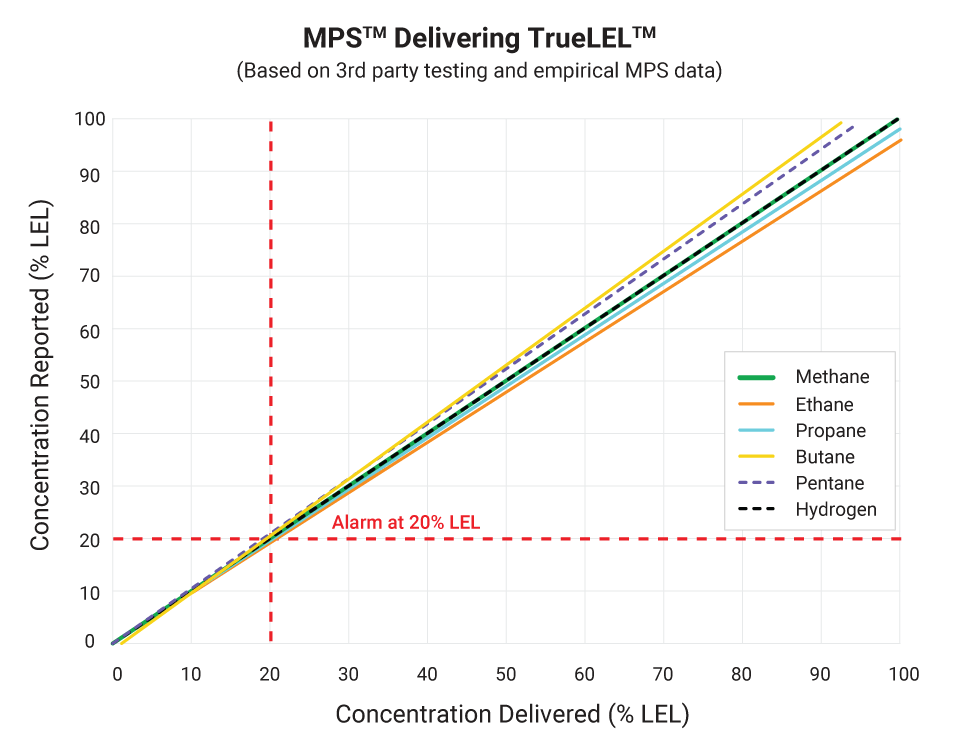
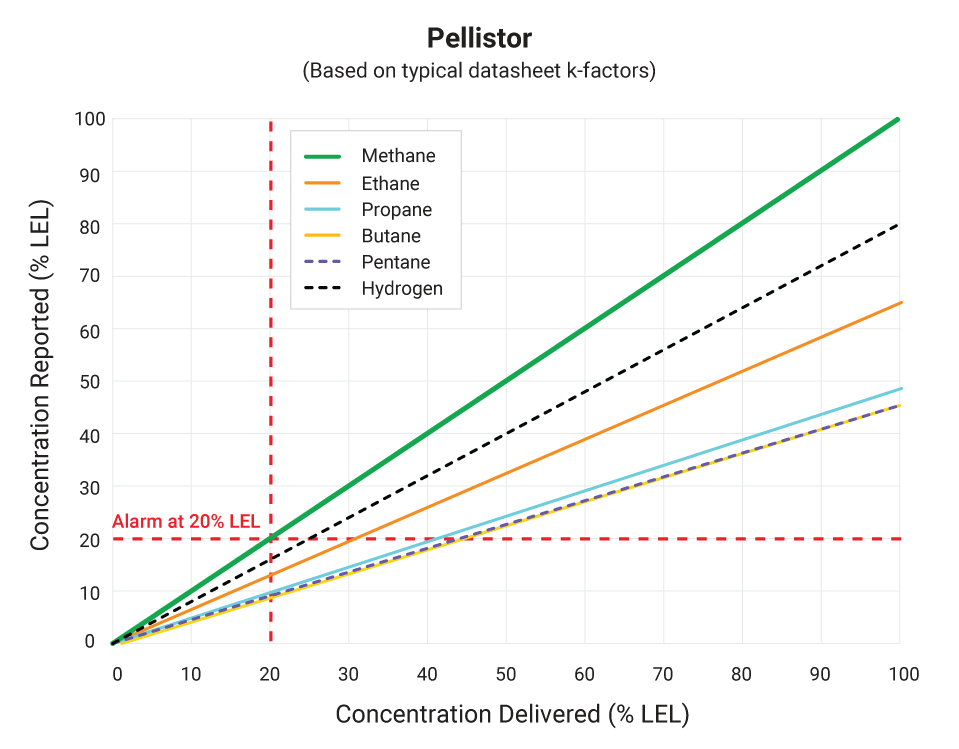
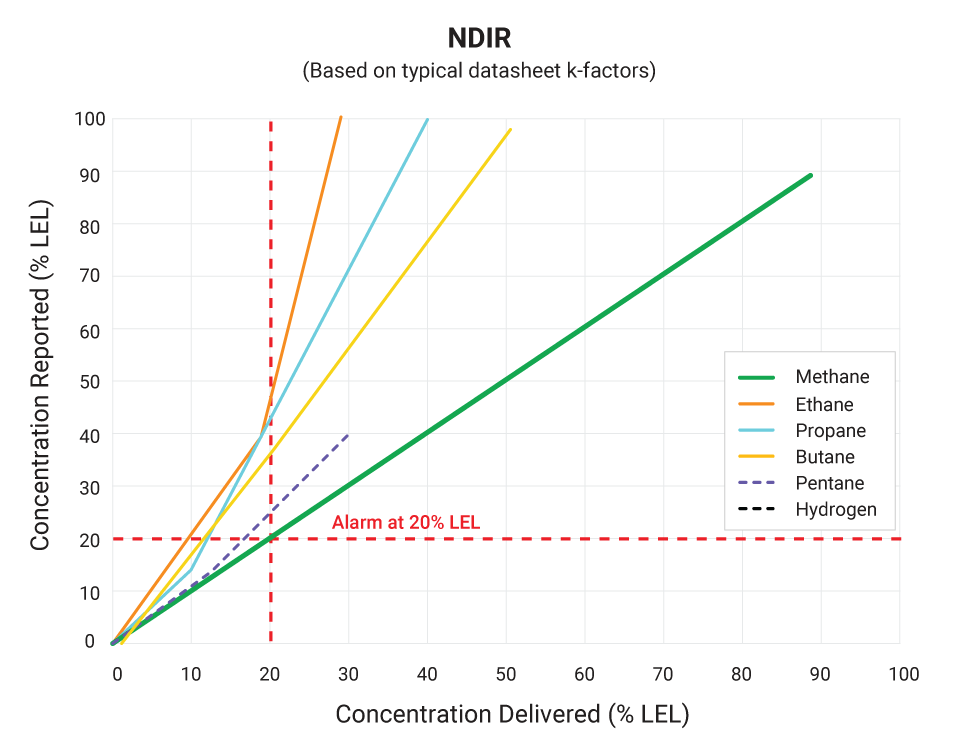
Are There Disadvantages to NDIR Sensors?
Video Demonstration: Comparing Sensor Performance of MPS™ Sensor vs. Catalytic Bead Gas Sensor and NDIR Sensors
In this demonstration, NevadaNano’s MPS™ Flammable Gas Sensor performance is compared to a catalytic bead gas sensor and an NDIR sensor when exposed to multiple flammable gases.
Is It Time to Replace Your Catalytic Bead Sensor?
If your device relies on catalytic bead sensor technology, the MPS™ 5.0 Flammable Gas Sensor offers a proven drop-in alternative — with configurable analog output designed to mirror your existing sensor without requiring a redesign of your device.