Close-Proximity Continuous Monitoring™
How Close-Proximity Continuous Monitoring™ Enables MethaneTrack™
NevadaNano’s Close-Proximity Continuous Monitoring™ (CPCM™) architecture enables MethaneTrack™ to locate the source and calculate the rate of emissions with much greater accuracy than other monitoring solutions operating from a greater distance, thereby significantly improving detection and quantification.
Why Close-Proximity Continuous Monitoring™ Reduces Total Emissions?
Methane emissions are cumulative. Every hour a leak remains active contributes additional emissions. Even relatively small leaks can release significant volumes of methane over weeks or months if left unrepaired.
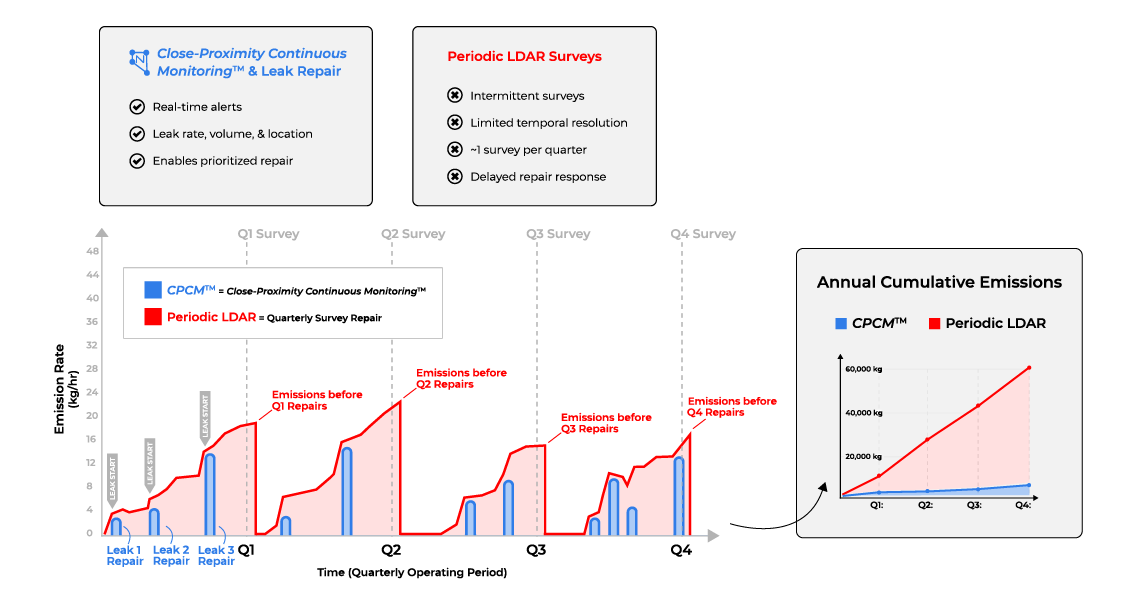
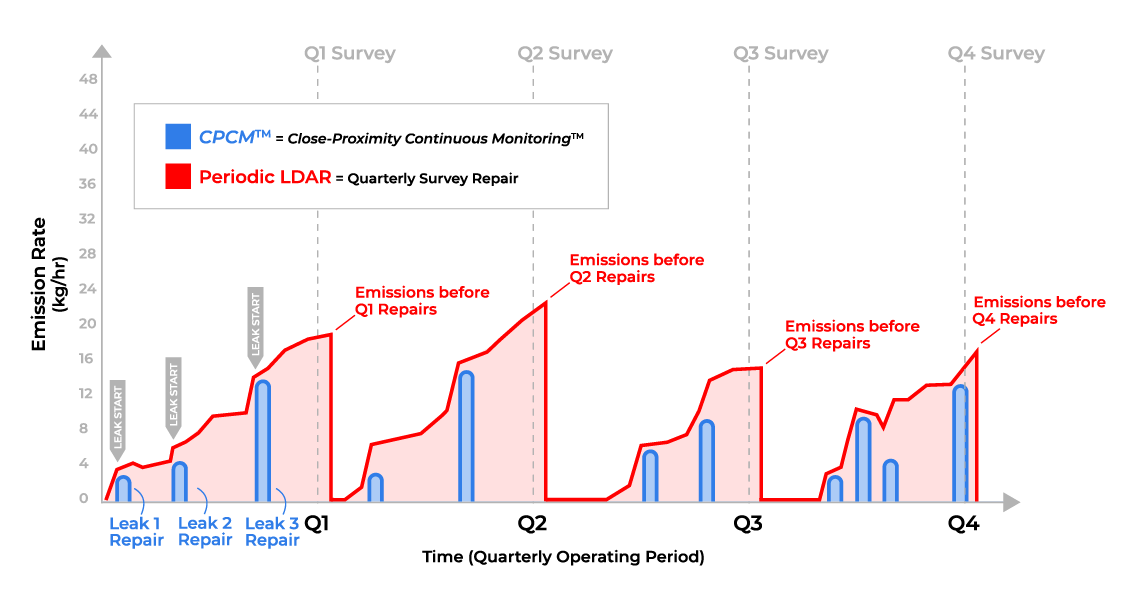
Periodic surveys provide only snapshots in time. If a leak begins shortly after a scheduled inspection, it may continue emitting until the next survey identifies it. Continuous monitoring eliminates these blind periods by detecting emission events as they occur, enabling maintenance teams to investigate and prioritize repairs sooner. Reducing the time between leak onset and repair can significantly lower the total methane emitted over the life of the leak.
The illustration below demonstrates why repair timing—not simply detection capability—is one of the biggest factors influencing total methane emissions. By detecting leaks close to the source and alerting operators quickly, Close-Proximity Continuous Monitoring™ helps shorten the time between leak onset and repair, reducing cumulative methane emissions.
What Is Close-Proximity Continuous Monitoring™?
Close-Proximity Continuous Monitoring™ is a key component of NevadaNano’s MethaneTrack™ automated emissions monitoring system architecture, in which strategically placed wireless gas sensing endpoints continually sample the surrounding air and send the data to a secure cloud, where Leak Source Isolation™ algorithms analyze the data to provide customers with leak alerts and to visualize cumulative emissions data in the MethaneTrack™ analytics and reporting platform. By detecting emissions right at or near the potential leak source — before the wind and other environmental factors significantly dilute the gas — CPCM™ increases measured concentrations and yields faster, more reliable detection and more accurate emission rates.
At its core, CPCM™ is enabled by wireless, intrinsically safe IIoT endpoints certified for the most hazardous environments, allowing them to be installed in Class I, Division 1 / Zone 0 locations where flammable gases are expected to be present. This means monitoring right where the leak risk is — not tens or hundreds of meters away.
Why Close Proximity Matters
Higher Emission Detection Accuracy
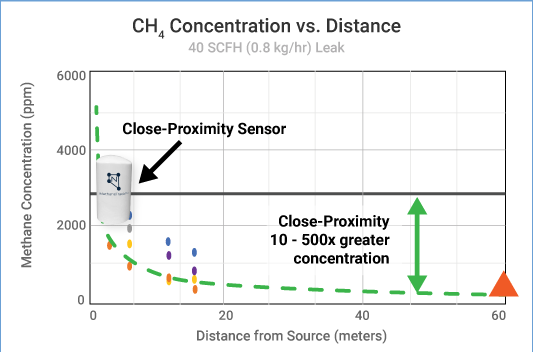
By placing sensors close to the emission source, CPCM™ increases the gas concentration by up to 500 times allowing the capture of stronger gas signals that have not been diluted or dispersed by wind, weather, or other environmental factors. This means leaks are detected sooner and with higher confidence.
Faster Response & Lower False Positives
Closer monitoring reduces noise and ambiguity in data, helping operators distinguish real emissions from background interference. It also means alerts are sent out sooner, enabling rapid mitigation.
Precise Leak Localization
Because the gas readings are taken near the source, the system can more accurately pinpoint the location of leaks — even in complex industrial layouts. This is especially valuable for directing repair crews immediately to the correct leaking asset.
Accurate Emission Quantification
Higher gas concentration readings mean more accurate calculations of emission rates, which is critical for compliance reporting and emissions reduction planning.
How MethaneTrack ™ with CPCM™ Works (Simplified)
Intrinsic Safety Enables Proximity
IIOT endpoints are certified for hazardous locations, allowing them to be installed on, or close to, potential leak sources.
Continuous Data Collection
Sensors take rapid, ongoing measurements of gas concentrations. Each endpoint takes 675 readings per hour, which equates to 16,000 readings per day and 5.9 million readings per year. This allows the system to capture and validate both intermittent and persistent leaks.
IIoT Integration & Cloud Analytics
Data streams from endpoints and anemometer feed into a cloud intelligence layer, where Leak Source Isolation™ (LSI™) algorithms analyze the data, validate leaks, and transmit leak location and quantification data to the dashboard analytics and reporting SaaS layer.
Actionable Data Intelligence
Operators receive automated alerts with location and emission rate information — enabling the rapid prioritization of repairs. The system provides automatic calculations of emissions for reporting and trend analyses.
Benefits of Close-Proximity Continuous Monitoring™
| Benefit | Why it Matters |
|---|---|
| Faster Leak Detection | Identify and repair leaks in minutes rather than days. |
| More Reliable Data | Reduced false positives and clearer differentiation between background noise and true emissions. |
| Accurate Localization | Pinpoint the leaking component or location for targeted maintenance. |
| Improved Regulatory Compliance | Better data quality for reporting under frameworks such as OGMP 2.0, EU, and EPA standards. |
| Lower Operational Costs | Faster repairs, fewer manual surveys, reduced downtime, and better use of personnel. |
Example: How Close-Proximity Monitoring Reduces Site Emissions
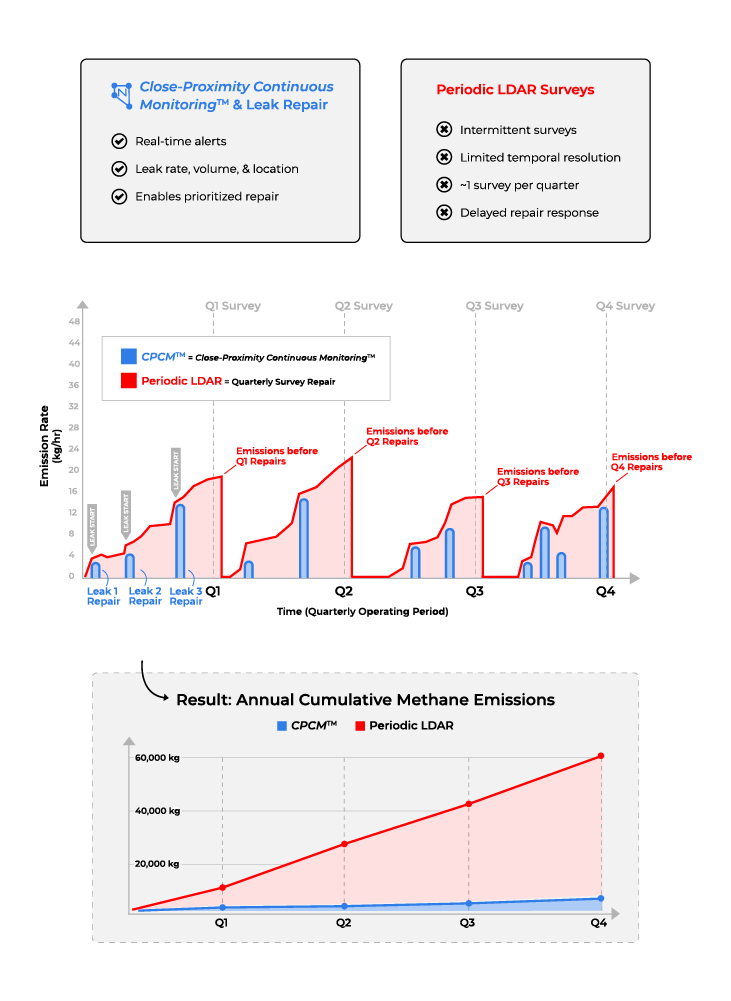
The previous example illustrates the principle that earlier repairs reduce cumulative emissions. In practice, Close-Proximity Continuous Monitoring™ helps operators detect leaks closer to the source, enabling faster investigation and repair than traditional periodic surveys. The example below demonstrates how reducing the time between leak onset and repair can significantly lower total methane emissions across a site, resulting in:
- Reduced cumulative methane emissions
- Reduced product loss
- Better maintenance prioritization
- Improved operational visibility
- Supports measurement-based methane programs